
I’ve had a lot of injuries over the years and ever since I read Anna’s awesome review I’ve wanted to do my own DNAfit test. I wanted to know if I was predisposed to getting injuries and what my recovery profile is like. Two things stopped me; the price and slightly irrational but genuine fear that I’d discover I have something wrong with me.
I registered an account on the DNAfit site, looked at the various kits, and then closed the site.
Ages ago, such a long time ago all the kits have been renamed on the site, an email grabbed my attention. DNAfit were offering 35% off all of their DNAfit kits. I logged onto the DNAfit website and after doing a spot of research ordered a kit before I could change my mind. I justified the purchase by telling myself that it was a reward for my recent promotion at work. A few days later the kit arrived and in typical Emma style, I proceeded to ignore it.
I think it took me a week to pluck up the courage to actually open the box and to read through the instructions. I discovered that because I’d just eaten, I couldn’t take the swab sample.

The following morning, I completed the mouth swab and posted off the sample in the pre-paid envelope provided before I could change my mind again. A couple of days later I received an email from DNAfit to say they’d received my sample. My results were ready a couple of weeks later. After some serious procrastinating, I plucked up the courage to look at my results.

My initial impression when I started exploring my results was something along the lines of wow, what a lot of information. I’m not ashamed to admit that I felt completely overwhelmed. I reminded myself that I have three science-related degrees and spent some time reading through the guidance before working my way through my Fitness Report and results.
This DNAfit review will focus on my personal infographic and a selection of the results of fitness genetics. If people are interested, I can look at my nutrition genetics in a separate post.
My infographic
Before I checked out my more detailed fitness and nutrition results, I looked at the handy infographic provided by DNAfit. Apologies for the terrible quality of the infographic, I debated including it in the review but decided to as it provides such a useful summary.

I’ve hopefully managed to upload a PDF copy of the infographic here so that if you want to, you can actually read what it says! A couple of data points grabbed my attention; that my injury risk was ‘high’ and that my recovery speed was ‘fast’.
Fitness genetics
“Let’s make your training and exercise choices more personal. We’ve analysed your DNA sample for a selection of the most-researched genetic variants connected with response to exercise. We are looking at everything from training intensity to sports injury predisposition.
Remember: Your genetic makeup is only one part of the picture, it is not a method of prediction or of identifying talent. We cannot use genetics to change our goal, rather to help reach that goal on a more personalised level, whatever that goal may be”
My fitness genetics dashboard contained links to a detailed Fitness Report and to the following (I’ve included the results for each) key markers:
I decided to explore my aerobic response, post-exercise recovery, and injury predisposition results in more detail. Where they are available, I’ve included a copy of the DNAfit gene tables for each of the key markers.
Understanding the DNAfit gene table
For each key marker in the fitness and nutrition reports, DNAfit analysed a selection of genetic variants. The variant you hold is known as an allele, and depending on which variation you possess DNAfit can report on the strength of its association with each of the DNAfit markers.
Each section of the fitness and nutrition reports contains my genotype breakdown, to help me understand how my individual genetic profile may affect my health and fitness choices. The symbols in the effect column indicate how strongly associated my genotype is with the relevant traits in the report as ‘..’ strong association, ‘.’ medium association and ‘-‘ no association.
I always knew that the term I spent studying genetics would come in handy one day. Thank you A-level biology!
Aerobic response
VO2 Max is the most popular measure of how well we utilise oxygen during exercise. When working out, the harder we work, the more oxygen we consume to produce energy. We all have a certain maximum point that we can reach with very hard exercise where we can no longer use more oxygen; this point is called the VO2 Max.
Evidence shows that when a large group of people embark on the same endurance training programme, some will see bigger improvements in VO2 Max utilisation than others. Variations in genes that form part of the cardiovascular and muscular system play a big role in determining how well we respond to improving our VO2 Max through exercise, and the genes included here can help indicate where we lie on this spectrum.
What will this tell me?
What will this not tell me?
My Aerobic Training Response
According to DNAfit, I have a HIGH RESPONSE to aerobic training based on my DNA, which suggests I would expect to see a higher than normal rate of improvement from aerobic training.
Here’s how DNAfit calculated my Aerobic Training Response score
The table below shows the genes DNAfit looked at for aerobic trainability. These are the most researched genes around VO2 Max response, they play a role across our cardiovascular and muscular system, and depending on the variants you possess can create a kind of genetic resistance to improving the VO2 Max level via exercise, or otherwise.
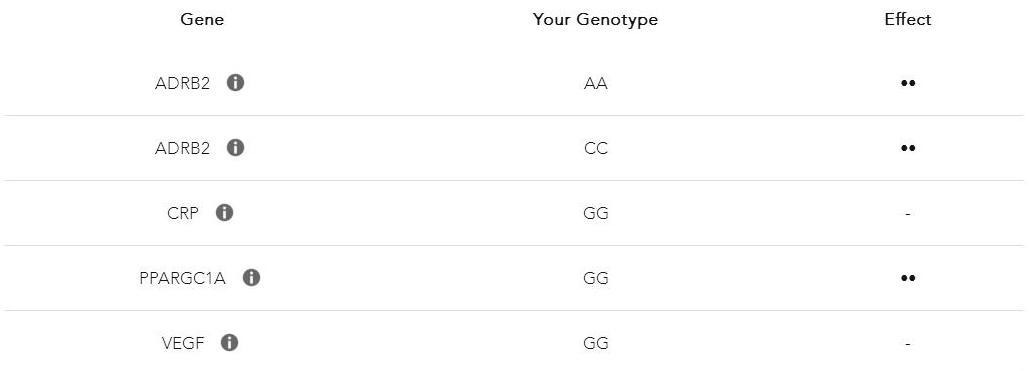
The table above shows the names of the genes DNAfit looked at, the version of those genes I possess and the strength of effect they have on my end aerobic training response result.
Post-exercise recovery
Recovery is an integral part of every training schedule, however, selecting the right recovery is personal
When exercising, some people are lucky enough to recover very quickly, they are ready to exert themselves again after limited rest. Whereas others don’t seem to bounce back quite as quickly, needing longer breaks between training sessions. Research has shown that certain genetic variations infer a delayed recovery from hard exercise training; those with these markers should take extra care with their training plan and nutrition strategy.
What will this tell me?
What will this not tell me?
My Genetic Recovery Profile
My recovery speed is FAST. My DNAfit assessment determined that I have variations in gene(s) important in free radical removal [SOD2]. In order to support my genetic profile, DNAfit recommended that I consume adequate amounts of antioxidants in my daily diet.
My DNAfit assessment indicated variations in gene(s) related to immune support and recovery [IL6, CRP]. In order to complement this genetic component, DNAfit recommended that I include Omega-3 fatty acids in my daily diet.
Here’s how DNAfit calculated my recovery score
The table below shows the genes DNAfit looked at for my genetic recovery panel. These are the most researched genes around metabolic stress from exercises, and these passed DNAfit’s evidence threshold for inclusion.

The table shows the names of the genes DNAfit looked at, the version of those genes I possess, and the strength of effect they have on my recovery score.
Injury predisposition
Our risk of sporting injury can vary between individuals and part of this difference is genetic.
Anyone that has trained others will know that for some, injury issues seem to occur more often. There are many factors to injury risk, from our technique (or bio-mechanics) to the kind of equipment we use or the surfaces on which we train. There is also a genetics factor.
What will this tell me?
What will this not tell me?
My Genetic Injury Predisposition
I have a HIGH PREDISPOSITION to connective and soft tissue injuries. I am much more likely to develop tendinopathies and tendonitis with regular training.
Apparently, 70% of DNAfits users have the same result so I’m most definitely not alone.
Here’s how DNAfit calculated my injury risk score
The table below shows the genes DNAfit looked at for their injury risk panel. These are the most researched genes around sporting injuries and have passed DNAfits evidence threshold for inclusion. The table includes the names of the genes looked at, the version of those genes I possess, and the strength of effect they have on my injury predisposition score.
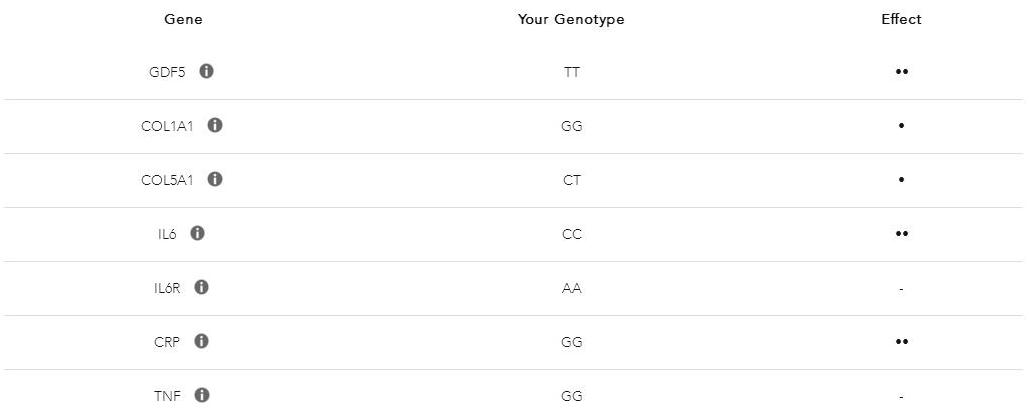
If you are at a raised risk of injury from the genetic aspect, and you are working out in a way that presents a risk, DNAfit recommend placing higher importance on preventative strength work and included links to Achilles strengthening, patella strengthening, and shoulder strengthening exercises.
The verdict and some final thoughts
So, would I recommend runners go out and purchase their own DNAfit test? Yes, but only if you genuinely think that you’d benefit from finding out more about how your genetic makeup influences your aerobic training, your predisposition to injuries etc. DNAfit tests are expensive, and I only treated myself because I was sent a 35% off discount code. As someone who runs as a hobby and for fun, there’s no way I could have justified paying full-price.
I found some of the results slightly unexpected. I didn’t expect to have a high response to aerobic training based on my DNA. This suggests I would expect to see a higher than normal rate of improvement from aerobic training. Based on my more recent experiences as a runner, the opposite has been the case and it’s taken a long time for my fitness levels to return.
The DNAfit assessment indicated that my recovery speed is fast. I’ve found the opposite and have struggled to recover from training sessions. Let’s just say I personally think that my recovery is so slow, there’s no way I could ever complete a multi-day race. DNAfit recommended that I consume adequate amounts of antioxidants in your daily diet. I hope that my new breakfast smoothie habit helps a little with this.
And finally, perhaps the least surprising result and one that made me feel a little better about my injury woes. Apparently, I have a high predisposition to connective and soft tissue injuries. This means that I am much more likely to develop tendinopathies and tendonitis with regular training.
**Full disclosure: I bought the DNAfit kit myself. The kit cost me £96.85 (RRP £149). I was not asked to review the kit but decided to share some of the results as I found them useful as a runner**

Member adidas Blogger Community

Top 10 Running Blog 2020

Top 10 Running Blog 2019

Top 10 Running Blog 2018

Decathlon Bloggers Community

Myprotein Award Winner 2017

Member UK Fitness Bloggers

Proud to support #RunEqual
