
Good morning and happy Monday! I hope that whoever reads this blog had an amazing weekend. I’ve got something slightly different for you this morning, some information about the state of Ultra Running in 2020.
Please don’t get your hopes up; I’m not planning on attempting an ultra marathon any time soon. I think 10k is about my limit.
I thought I’d share the results of a recent study carried out by RunRepeat.com in partnership with the International Association of Ultrarunners. The study explored the trends in ultra running over the last 23 years, and analysed 5,010,730 results from 15,451 ultra running events. That’s an impressive amount of number crunching and data analysis.
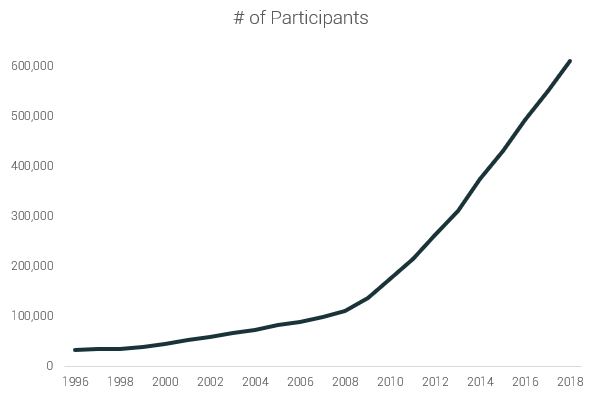
The State of Ultra Running 2020 is the first ever comprehensive look at the rapidly-growing sport of ultra running. The report shows that participation in ultra running events is on the rise with a 1676% increase in participation since 1996. There were just 34,401 ultra running participations back in 1996 and now there are 611,098.
As a keen parkrunner, one of the most interesting findings to me is that after 2015, the researchers identified a decline in participation in 5k events, and a levelling off in participation in marathons.

This appears to suggest that the most dedicated runners are looking for bigger and bigger challenges as running becomes more and more popular and marathon running is considered more mainstream than extreme.
I don’t want to replicate the full report here, however, I think it’s definitely worth sharing the key findings from the study with you.
Key findings:
Female ultra runners are faster than male ultra runners at distances over 195 miles. The average female pace is 17:19 min/mile, which is 0.6% faster than the average male pace of 17:25 min/mile.
Participation has increased by 1676% in the last 23 years from 34,401 to 611,098 yearly participations and 345% in the last 10 years from 137,234 to 611,098. There have never been more ultra runners.
More ultra runners are competing in multiple events per year. In 1996, only 14% of runners participated in multiple races a year, now 41% of participants run more than one event per year. There is also a significant increase in the % of people who run 2 races a year, 17.2% (from 7.7% to 24.9%) and 3 races, 6.7% (from 2.8% to 9.5%).
Women are as fast as men in long-distance ultras. The longer the distance the shorter the gender pace gap. In 5Ks men run 17.9% faster than women but on a 100-miler the difference is just 0.25%.
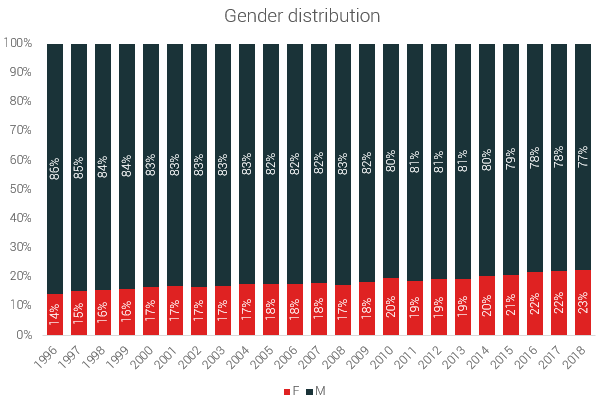
There have never been more women in ultra running. 23% of participants are female, compared to just 14% 23 years ago.
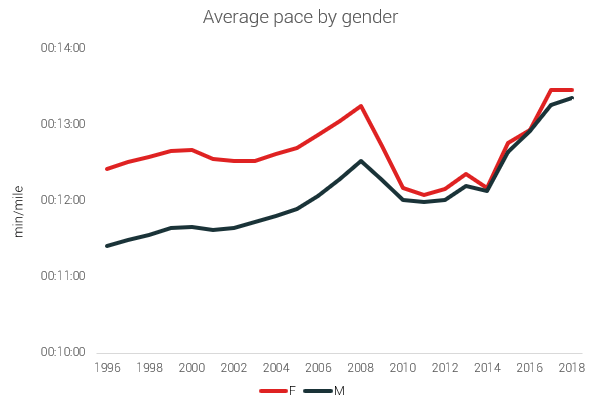
Ultra runners have never been slower across distance, gender and age group. The average pace in 1996 was 11:35 min/mile, currently it is 13:16 min/mile. The average runner has added 1:41 min/mile to their average pace, which is a slowdown of 15% since 1996. The authors don’t believe that individual runners have become slower, but that these distances are attracting less prepared runners now because the sport is more mainstream.
Runners improve their pace in their first 20 races and then their pace stabilises. From their first to their second race runners improve by 0:17 min/mile (2%) on average. But by their 20th they improve by 1:45 min/mile (12.3%).
The fastest ultra running nations are South Africa (average pace 10:36 min/mile), Sweden (11:56 min/mile), and Germany (12:01 min/mile).

A record amount of people travel abroad for ultra running events. 10.3% of people travel abroad to run an ultra, for 5k events this percentage is just 0.2%.
Runners in the longer distances have a better pace than the runners in the shorter distances for each age group.

All age groups have a similar pace, around 14:40 min/mile. Which is unusual compared to the past and to other distances.
The average age of ultra runners has decreased by 1 year in the last 10 years. It has changed from 43.3 years to 42.3 years.
You can view the full study and findings on the RunRepeat site here.
**Full disclosure: I didn’t receive monetary payment for writing this post; I personally found the ‘State of Ultra Running report 2020 really interesting and wanted to share the main findings on my blog. All infographics were obtained from the report **
Have you ever completed an ultra distance run? Just thinking about running any further than a marathon makes my fragile right foot twinge.
Did you find any of the main findings of the State of Ultra Running 2020 unexpected? Given how popular parkruns are, I didn’t expect there to have been a decline in participation in 5k events. Perhaps parkruns weren’t included in the assessments are they aren’t officially classed as races.

Member adidas Blogger Community

Top 10 Running Blog 2020

Top 10 Running Blog 2019

Top 10 Running Blog 2018

Decathlon Bloggers Community

Myprotein Award Winner 2017

Member UK Fitness Bloggers

Proud to support #RunEqual

I agree that they probably didn’t include parkruns in the 5k as they aren’t races, and really with them being on each weekend they would probably mess up the results. Also I do think there are less 5k races around nowadays. No, I’ve never been tempted by an ultra! Really the time to train just takes too much time for me.