
I’d like to start by saying good morning, good afternoon, good evening, etc, and happy Wednesday. I hope that everyone who reads this slightly overdue collection of mini book reviews had an amazing Christmas and New Year. I can’t believe I’m back at work tomorrow. My two and a half weeks of annual leave flew by in a blur of food, family, board games, books, TV, and afternoon naps. I’m really going to miss my afternoon naps! 🙁
Since the first lockdown last March, I’ve been trying to read more. I’m aware that I’m repeating myself, apologies, but books have provided me with a welcome break from the real world. Books have also provided my eyes with a much-needed break from my work and personal laptop screens. I’m waffling on as per usual, but if you haven’t already done so, please check the rest of my ‘Books I’ve read recently’ posts.
Books I’ve read recently #1 | Books I’ve read recently #2 | Books I’ve read recently #3 | Books I’ve read recently #4
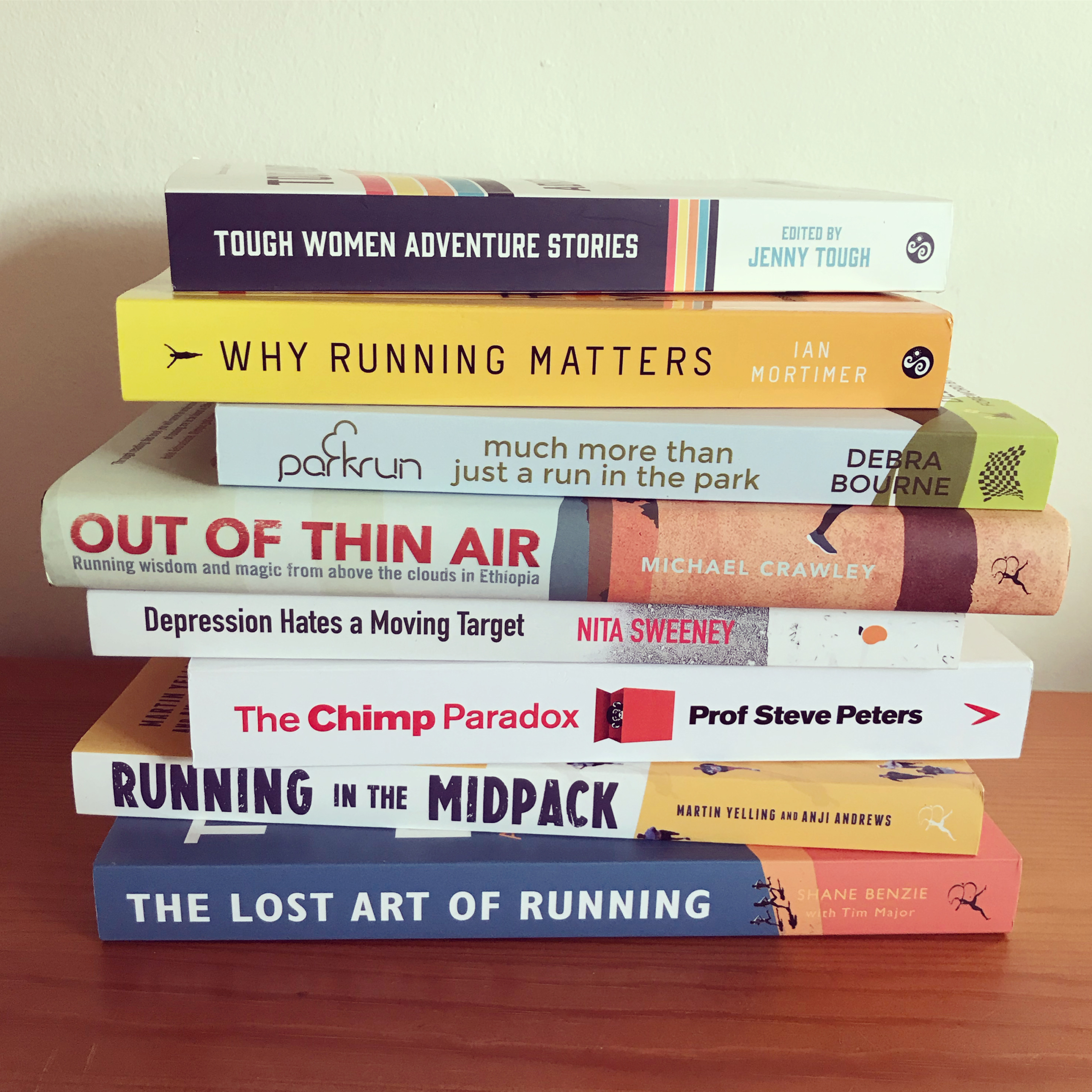
Below are short(ish!) reviews of the running-related books I read between May and November. I’m aware that it’s been a long time since I published my last ‘Books I’ve read recently’ post, I’ve read a lot of what I’d describe as non-running related books. All the books were new to me and were purchased using a local recognition award voucher I received from work. Like last time, I’ve also included the books I’m currently reading. Wherever possible, I’ve included links to either the publisher or to the author of each book rather than to Amazon.
Books I read between May and November
The Lost Art of Running: A Journey to Rediscover the Forgotten Essence of Human Movement by Shane Benzie
As a runner with what I’d describe as a wonky, rather unique running style, and a long history of what I now know are self-inflicted running injuries, I found ‘The Lost Art of Running’ fascinating. I thought I knew a lot about running technique, the contents of ‘The Lost Art of Running’ made me realise I’m a complete novice when it comes to running technique.
I would describe ‘The Lost Art of Running’ as a part travelogue and part a guide to running. It follows the author’s personal story into how he came to develop an understanding of how we can become better runners; namely by running like we used to run before modern life gave us bad habits that now have a detrimental impact on how we run. Disclaimer, sitting at a computer all day does absolutely nothing to help our running unless we are spending the time to research the concepts the author introduces in this book.
I personally found the sections where the author describes his travels around the globe and his accounts of how some of the top athletes have had their running improved by making some quite simple changes to their running technique really informative. I’ll never be a top athlete, but when I’m back up and running again, re-reading the third section of ‘The Lost Art of Running’ will be one of my priorities. This final section contains 40 pages of practical advice for good running form and is broken down into the main components of running (stride, cadence, etc) and also explains the author’s theory around fascia and elastic running.
And what about the not-so-positive aspects of ‘The Lost Art of Running’? I thought that the book was slightly lacking in images and diagrams, for example, I had to go away and find out what a tensegrity model actually is as I didn’t have a clue what the author was talking about. The travelogue sections which make up a large proportion of the ‘The Lost Art of Running’ were slightly lacking in detail in places and I was left wanting to know more about some of the amazing places the author visited.
I want to rediscover my love for running and I know that I need to improve my running form. I’m hopeful that if I apply at least some of the concepts the author introduced in ‘The Lost Art of Running’ I’ll be able to do both. While I don’t think a book like ‘The Lost Art of Running’ will ever replace a good running coach, I do think that some of the concepts and techniques that are outlined in the book have the potential to assist runners who spend more time unable to run due to running injuries than actually running.
parkrun: much more than just a run in the park by Debra Bourne
I love parkrun and would describe myself as a parkrun volunteering addict. I also love reading about parkrun, so when parkrun was temporarily suspended last summer, I finally purchased and read ‘parkrun: much more than just a run in the park’ written by Debra Bourne.
I’ve been receiving weekly parkrun UK newsletters by email since I registered as a parkrunner in 2008(ish), so I’d always assumed that I had a fairly good understanding of the history of parkrun; I didn’t. I enjoyed finding out more about the early days of what has become a global phenomenon. The book delves into the beginnings of parkrun, a time trial held on October 2nd, 2004, in Bushy Park in London, and then charts the development of parkrun in the United Kingdom and globally up to when the book was published in 2014. The book discusses the challenges the first parkruns faced and provides an insight into exactly what is involved when a new parkrun is set up.
Although I enjoyed all of the book, I particularly enjoyed learning a little about what goes on behind the scenes at parkrun HQ and about the differences between countries and I now know why parkrun start times vary depending on location.
I would recommend that anyone who loves parkrun reads this book, however, the book was published in 2014, so although the information on the history of parkrun is still relevant, parkrun is constantly evolving so some of the information in the book is now out of date.
Why Running Matters: Lessons in Life, Pain and Exhilaration – From 5K to the Marathon by Ian Mortimer
‘Why Running Matters’ is a year-long memoir which might be described as a historian’s take on Haruki Murakami’s ‘What I Talk About When I Talk About Running’. Murakami’s book is probably one of my favourite running books, so I had quite high expectations when I started reading ‘Why Running Matters’. The book covers the parkruns and races run by the author in 2017 following a New Year’s resolution to run 45 parkruns and 5 half marathons in 12 months. And I thought that I set myself challenging New Year’s resolutions!
When I finished reading ‘Why Running Matters’ I had such mixed feelings about the book, I decided to read some of the reviews on Amazon and Goodreads. It quickly became apparent that ‘Why Running Matters’ is a book that divides people; people appear to either love or hate the book. I don’t want to go into too much detail, but I found the review left by the author’s daughter the most informative as she responded directly to some of the negative feedback left by other people relating to her absence from the book.
Let’s get the negatives out of the way first as there are a few. I felt that what I’d describe as casual sexism permeated throughout ‘Why Running Matters’. I lost count of the number of times the author objectified the women he encountered at parkrun. As a female runner, I found some of the author’s descriptions of female parkrunners incredibly distasteful, and rather naively as it turns out, not something I thought I’d read in a running book published in 2019. At the end of the day, when I’m not injured, I run for myself and not to provide a distraction or motivation to male parkrunners. I’m sure other female parkrunners have the same attitude.
Notwithstanding the casual sexism, the author also seems to be obsessed with finishing in the top 20 percent at parkrun, and at one point bemoans his younger son’s slow target time of 25 minutes, way outside the top 20 percent. This indicates to me that the author has completely missed the point of parkrun. I was left with the feeling that the author would do well to volunteer a bit more at his local parkrun. The way the author referred to the “competition” with his two sons got slightly grating after a while as did the way the author treated every run like a race, regardless of whether the people involved were even aware.
And what about the positives? I thought that ‘Why Running Matters’ was well written with short chapters that made it easy to read. I enjoyed reading the historical snippets such as the history of running and the history of numbers. As a parkrun obsessive, I appreciated the volunteer list at the end of the book.
Unfortunately, due to the reasons I’ve already discussed, I don’t think I would recommend ‘Why Running Matters’ to other runners.
Depression Hates a Moving Target: How Running with my Dog Brought me Back From the Brink by Nita Sweeney
A friend who was aware I was struggling with my mental health recommended that I read ‘Depression Hates a Moving Target’. I must admit that I was a little concerned reading about someone else’s experiences and battles with depression would make me feel even worse than I already did. A rather selfish attitude, but I was aware that I needed to do everything I could to protect myself.
I’m pleased that I eventually plucked up the courage to read ‘Depression Hates a Moving Target’. The author’s personal and running journeys were both incredibly inspiring. The author describes her journey from finding the strength and courage to head out on her first training run, to running her first 5k, her first half marathon, to eventually completing her first marathon.
‘Depression Hates a Moving Target’ is fast-paced and so easy to read, I ended up reading it in one sitting one Sunday last summer. It made me want to pull on my trainers and run, unfortunately, this was something I wasn’t able to do because of my knee injury. I found myself wondering how the author would have coped with a long-term, persistent injury and then hated myself for feeling jealous of someone who has had to cope with depression, anxiety, panic attacks, and bereavement.
I appreciated the fact that the book had 26.2 chapters, little things please little minds. I thought that the conclusions and resources section at the end of the book where the author shared some of her favourite tips would be useful for people new to running.
I think that ‘Depression Hates a Moving Target’ is a fantastic book about mental health, running, and setting and achieving goals. Just a word of caution, the cover, and subtitle of the book is a little misleading, I expected there to be more about the trials and tribulations of running with a dog.
Tough Women Adventure Stories: Stories of Grit, Courage and Determination by Jenny Tough
When I asked for running book recommendations, a book I hadn’t previously come across during my research – the ‘Tough Women Adventure Stories’ – cropped up a few times. Although the book isn’t strictly speaking a running book, I generally enjoy reading about women who are far braver than I’ll ever be, so I bought myself a copy.
Edited by Jenny Tough, a Canadian mountaineering expert, the ‘Tough Women Adventure Stories’ book contains the extraordinary stories of twenty-two “badass outdoorswomen” including Sarah Outen, Anna McNuff, Emily Chappell, and Vedangi Kulkarni who undertake awe-inspiring adventures across the globe. So, what did I think about the book?
I think I made a fundamental mistake when I read this book. I read the book in one sitting; on reflection, I think this is the kind of book that is better read one or two chapters at a time. Although the ‘Tough Women Adventure Stories’ book contains some amazing, compelling stories, after a while they all started to feel quite same-y. In addition, although all of the women are clearly “badass outdoorswomen”, they weren’t always good storytellers. This meant that while some of the stories were fascinating and real page-turners, others were a bit of a slog to get through. So, my top tip would be to dip into this book rather than reading it all in one go.
I’m not a risk-taker by nature, so I, unfortunately, found it quite hard to relate to a lot of the women. I also found the stories where the women quite seriously neglected or endangered their own health in order to achieve the goals they had set for themselves quite hard to read. I was left asking myself the question would it have taken more toughness to fail or to say no.
So, I, unfortunately, didn’t enjoy reading this book as much as I thought I would. Although I really enjoyed some of the stories, my favourite was probably the story written by Sarah Outen, others I didn’t enjoy reading at all. As I found it hard to relate to a lot of the women, I found several chapters quite boring and ended up skim reading some of the book. I think that fewer, slightly more detailed stories would make the book a much better overall read.
Running in the Midpack: How to be a Strong, Successful and Happy Runner by Martin Yelling and Anji Andrews
I could and probably should introduce a third category of books to this series of ‘Books I’ve read recently’ posts. This category would be called something along the lines of ‘Books I tried to read several times but gave up reading, ‘Books I found too difficult to read’, or ‘Books I failed to read’ or ‘Books I started to read but couldn’t get into’ I’m sure you get the idea.
I feel terrible writing this and I don’t want this review to sound negative, but after spending several months trying and failing to read ‘Running in the Midpack’ – I found it impossible to what I describe as ‘get into’ the book – I decided to put the book back on my bookshelf. Perhaps being a back of the pack, injury-prone runner meant that I wasn’t the target audience for a running book named ‘Running in the Midpack’. The generally positive reviews I read on Amazon and Goodreads led me to believe that it’s not the book that’s at fault.
Anyway, enough negativity! If anyone who reads this would like my pretty much unread copy of ‘Running in the Midpack’ please message me.
Books I’m currently reading
Out of Thin Air: Running Wisdom and Magic from Above the Clouds by Michael Crawley
When I asked for running book recommendations on Twitter, several people recommended ‘Out of Thin Air’. I don’t want to make excuses, but for some reason, I’ve not made the time to finish this book. I read the first few chapters a few months ago and then for some reason started to read another book. My memory is terrible, so I decided to start reading this book a second time from the beginning. I’ve only reread the first chapter, but this is another running book I know that I’ll keep when I’ve finished reading it.
The Chimp Paradox by Professor Steve Peters
I’ve lost count of the number of people who have told me to read ‘The Chimp Paradox’. I’ve also lost count of the number of times I started to read this book but got side-tracked and started to read a less challenging book. Once I realised that I needed to take the book seriously and that I needed to spend some time working through the assignments set out in each chapter, I’ve been reading the book at a more sensible and digestible pace. I don’t think I’ll be donating this book to the local charity bookshop when I eventually finish reading it.
Books I’m aiming to read next
My family was very generous this Christmas, so I now have a pile of running-related and other books waiting to be read. I’m currently reading a couple of books a week, so if everything goes to plan, it won’t take me several months to share my next selection of mini book reviews on here.
And finally, if you’d like me to send you my copy of ‘Running in the Midpack’ please message me on here or on Instagram/Twitter @thephdrunner
Have you read any running-related books recently you’ve enjoyed? I’m always on the lookout for good books, so if you have, please share your recommendations with me.
Are there any running-related books you think I should definitely avoid? Please let me know so that I can save my pennies.

Member adidas Blogger Community

Top 10 Running Blog 2020

Top 10 Running Blog 2019

Top 10 Running Blog 2018

Decathlon Bloggers Community

Myprotein Award Winner 2017

Member UK Fitness Bloggers

Proud to support #RunEqual

I’m the same with Running in the Midpack- I have tried a few times to get into it, and wish I did because I really like the authors, but I just can’t really get it.
Hi Maria, my WordPress account is finally letting me reply to comments. Sorry for looking like I’ve been ignoring your comments for such a long time.
I’m kind of relieved to discover that I’m not the only person who tried and failed to get into ‘Running in the Midpack’. Like you, I really like the authors, but I just couldn’t get into the book. It’s rare for me to ‘DNF’ a book, especially a book about running.
When I’m not running, or talking about running, then I’m reading about running 😉
It’s mostly blogs etc, but I do quite like getting a book, devouring it, and then passing it on to fellow running buddies. I’ve not read any of these ones yes but ‘Depression Hates a Moving Target’ sound very good so I’ll add that to my wanted list.
Hi Adem, after far too many months, I’ve managed to access the comments section of my blog. Sorry for taking months to reply to your comment.
After I set myself a target of reading at least 100 books in 2022, I’ve been reading a lot this year. I pop into the local charity bookshop and pick out a selection of books. After having some issues with my eyes, I’ve tried (and failed!) to cut down the number of blogs I read.
I’ve read a few more running related books since writing this blog and will be publishing another ‘Books I’ve read recently’ post soon. Did you end up buying ‘Depression Hates a Moving Target’? If you want me to send you my copy, please let me know.